Key Components & Specifications
- Main Structure: Hot-dip galvanized and powder-coated steel frame for corrosion resistance and long service life (typically 10+ years).
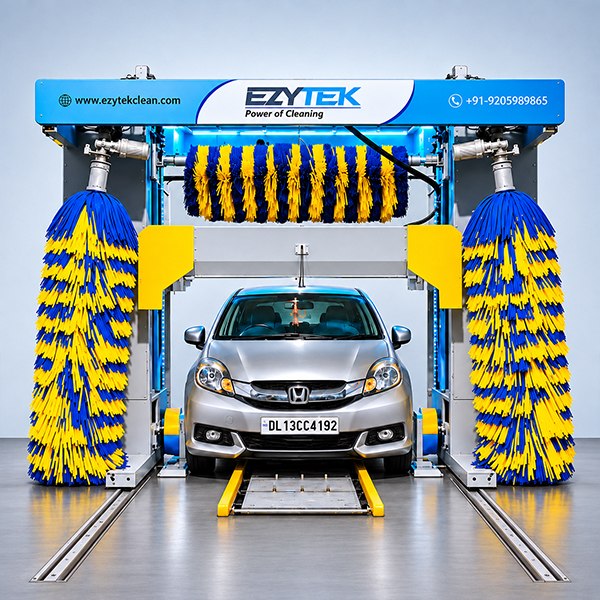
- Brushing System: Usually features 3 brushes — 2 vertical brushes for side panels and 1 horizontal brush for the top, equipped with electronic pressure sensing (and luggage/roof rack avoidance circuits) to protect vehicle paint.
- Automated Cycle Sequence: Complete washes typically follow an Auto Jet-Brush-Foam-Wax-Dryer sequence:
- Pre-wash / High-pressure jet wash
- Foam application
- Mechanical brush scrub + wheel/rim brushes
- Rinse cycle
- Wax application for a protective finish
- Automatic profile-following air dryer.
- Underbody Wash: Integrated robotic gantry with oscillating nozzles (e.g., 9+ nozzles) for chassis and wheel cleaning.
- Control & Sensors: Managed via a PLC (Programmable Logic Controller) and touch-screen HMI (Human-Machine Interface) panel with ultrasonic/infrared sensors for vehicle positioning.
Technical Specifications
| Total Brushes | 3 (2 vertical side brushes and 1 horizontal top brush). |
| Brush Material | Soft foam |
| Pump | Triple ceramic plunger pump |
| Nozzle Pressure | 150 Bar nozzle pressure |
| Water Consumption | 75 to 140 liters per vehicle |
| Underbody Wash | Typically 9 oscillating nozzles |
| Drying Unit | automatic profile dryer |
| Power Requirements | 11 kW to 18 kW |
| Cycle Duration | 6 to 9 minutes per full wash-and-dry cycle. |